

Autonomous Forklift Market Growth Accelerates with 13.1% CAGR During the Forecast Period to 2035
Autonomous Forklift Market
Autonomous Forklift Market Size, Share and Research Report By Tonnage Capacity (Below 5 Tons, 5–10 Tons, Above 10 Tons), By Navigation Technology(Laser, Optical
Autonomous Forklift Market - Accelerated by warehouse automation, rising labor costs, and the need for 24/7 material handling efficiency in modern supply chains.”
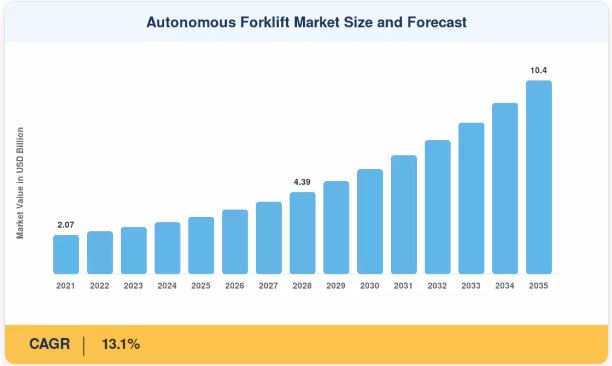
NEW YORK,, NY, UNITED STATES, September 2, 2026 /EINPresswire.com/ -- The Global autonomous forklift market reached an estimated USD 3.06 billion in 2025 and is projected to grow from USD 3.43 billion in 2026 to USD 10.40 billion by 2035, registering a CAGR of 13.1% during the forecast period. Two major catalysts are accelerating this trajectory: the acute global warehouse labor shortage with logistics operators across North America, Europe, and East Asia reporting persistent unfilled picking and material handling positions and the rapid maturation of LiDAR-SLAM navigation and AI-powered fleet orchestration technologies that have dramatically narrowed the performance gap between autonomous and human-operated forklifts. With global e-commerce order volumes projected to surpass USD 8.5 trillion annually by 2030, warehouse and distribution center operators face mounting pressure to automate material handling operations or risk being outpaced by competitors who have already deployed autonomous intralogistics solutions.— Market Research Future (MRFR)
Legacy manually operated counterbalance and reach forklifts dependent on certified operators, subject to fatigue-related errors, and costly to insure are rapidly giving way to autonomous mobile robot (AMR) forklifts and automated guided vehicle (AGV) systems that integrate 3D vision, real-time obstacle avoidance, and warehouse management system (WMS) APIs. A recent McKinsey Global Institute analysis estimated that top-quartile distribution centers deploying autonomous forklift fleets alongside intelligent slotting algorithms reduced labor costs by 35–42% while simultaneously improving throughput by 28–34% compared to manually operated peers. This technology shift is not incremental it represents a fundamental restructuring of how global supply chains handle unit loads from receiving dock to final dispatch.
Get Full PDF Sample Copy of Report: (Including Full TOC, List of Tables & Figures, Chart) @
https://www.marketresearchfuture.com/sample_request/21410
➤ How Significant Is the Autonomous Forklift Market’s Growth?
The autonomous forklift market has demonstrated exceptional and accelerating expansion, rising from approximately USD 3.78 billion in 2021 to an estimated USD 3.06 billion in 2025, representing one of the strongest historical growth trajectories in the broader industrial automation sector. The market is poised to nearly triple over the next decade, driven by the convergence of labor cost pressures, advances in robotic navigation, declining sensor hardware costs, and the explosive growth of fulfillment infrastructure serving omnichannel retail and third-party logistics (3PL) operators.
Rising injury rates associated with manually operated forklifts which account for approximately 85 fatalities and 34,900 serious injuries annually in the U.S. alone according to OSHA data are creating compelling safety-driven mandates for autonomous alternatives. Simultaneously, cold-chain logistics operators in food and pharmaceutical distribution are accelerating autonomous forklift adoption to address the extreme difficulty of recruiting human operators willing to work in sub-zero environments for extended shifts. Financial institutions, automotive manufacturers, semiconductor fabs, and large-format retail distribution centers are all investing heavily in autonomous forklift ecosystems to reduce write-offs from product damage, shorten cycle times, and eliminate bottlenecks tied to human shift constraints.
➤ What Does the Future Hold for the Autonomous Forklift Market?
Artificial intelligence and next-generation perception technologies stand at the forefront of the market’s next growth phase. AI-driven fleet orchestration platforms are transforming autonomous forklifts from isolated robotic units into coordinated, self-optimizing intralogistics networks. Modern deployments integrate real-time task allocation algorithms that dynamically assign lifts, routes, and charging sequences across fleets of 50 to 500+ autonomous vehicles maximizing throughput while minimizing energy consumption and traffic conflicts within warehouse aisles.
The growing emphasis on flexible, infrastructure-light autonomous navigation is another defining force shaping the market’s future. Early AGV forklifts required magnetic tape, reflective targets, or fixed guidewires infrastructure investments that limited deployment flexibility and imposed significant reconfiguration costs. Modern natural-feature navigation systems using LiDAR-SLAM, vision-SLAM, and AI-based map-learning enable autonomous forklifts to be deployed in existing warehouses within days rather than months, dramatically lowering the barrier to adoption for mid-market operators.
Integration with warehouse management systems, enterprise resource planning (ERP) platforms, and order management systems is also redefining the value proposition. Autonomous forklifts that serve as connected nodes within a broader digital supply chain sharing real-time inventory location data, pallet condition assessments, and throughput telemetry are enabling a new generation of inventory visibility and predictive replenishment capabilities that transcend the productivity gains of automation alone.
Direct Purchase this Research Report:
https://www.marketresearchfuture.com/checkout?currency=one_user-USD&report_id=21410
➤ Who Are the Key Players in the Autonomous Forklift Market?
The autonomous forklift landscape is characterized by a mix of established material handling OEMs, specialist AMR/AGV technology companies, and well-funded robotics startups. Key participants shaping the competitive dynamics include:
• Toyota Industries Corporation
• KION Group (Linde Material Handling & STILL)
• Jungheinrich AG
• Crown Equipment Corporation
• Hyster-Yale Group
• Seegrid Corporation
• Vecna Robotics
• 6 River Systems (Shopify)
• Balyo
• Corecon / Logistics Motion
Competition in the market is intensifying as traditional forklift OEMs accelerate in-house autonomous development programs while simultaneously acquiring or partnering with specialist AMR startups. The race to offer turnkey autonomous intralogistics solutions combining hardware, software, fleet management, and maintenance-as-a-service is reshaping the vendor landscape and consolidating market share toward vertically integrated platforms.
➤ What Are the Emerging Trends in the Autonomous Forklift Market?
Several transformational trends are redefining how the autonomous forklift market evolves through 2035:
AI-Powered Fleet Orchestration: Multi-vehicle coordination platforms using reinforcement learning and digital twin simulation are enabling autonomous forklift fleets to self-optimize routing, task prioritization, and charging schedules in real time maximizing throughput without human intervention.
Infrastructure-Free Natural Navigation: LiDAR-SLAM and vision-SLAM navigation systems are eliminating the need for magnetic tape, reflective targets, or fixed guidewires, enabling rapid deployment in existing warehouses and dramatically reducing upfront installation costs.
Robotics-as-a-Service (RaaS) Adoption: Fleet-based subscription models offering autonomous forklifts on a per-pick or per-shift pricing basis are lowering capital expenditure barriers for mid-market operators and enabling variable-capacity scaling aligned with seasonal demand fluctuations.
Cold Chain and Hazardous Environment Expansion: Autonomous forklifts purpose-engineered for sub-zero temperatures, cleanroom standards, and explosive atmosphere (ATEX) compliance are unlocking high-value segments in pharmaceutical, food & beverage, and chemical distribution.
Human-Robot Collaboration (HRC) Frameworks: Hybrid deployments where autonomous forklifts handle high-frequency, repetitive pallet movements while human operators manage exception handling, quality inspection, and complex put-away tasks are becoming the dominant implementation model in mixed-SKU fulfillment environments.
Predictive Maintenance and Digital Twin Integration: Embedded IoT sensor suites transmitting real-time drivetrain, battery, and fork mechanism telemetry to cloud-based predictive maintenance platforms are enabling condition-based service models that reduce unplanned downtime by 40–55% compared to scheduled maintenance regimes.
Get access to the full description of the report @
https://www.marketresearchfuture.com/reports/autonomous-forklift-market-21410
➤ How Is the Autonomous Forklift Market Segmented?
The autonomous forklift market report provides a comprehensive segmentation framework:
1. By Navigation Technology: LiDAR-SLAM, Vision-SLAM, Magnetic Guidance, Natural Feature Navigation, Hybrid Navigation
2. By Forklift Type: Counterbalance Forklift, Reach Truck, Order Picker, Pallet Truck, Stacker, Tugger/Tow Vehicle
3. By Payload Capacity: Up to 1,000 kg, 1,001–3,000 kg, 3,001–5,000 kg, Above 5,000 kg
4. By End-Use Industry: E-Commerce & Retail, Automotive, Food & Beverage, Pharmaceutical & Healthcare, Manufacturing, Third-Party Logistics (3PL)
5. By Business Model: Outright Purchase, Leasing, Robotics-as-a-Service (RaaS)
➤ What Are the Regional Insights from the Autonomous Forklift Market?
North America commands approximately 36% of global autonomous forklift market share, underpinned by the region’s vast e-commerce fulfillment infrastructure, acute warehouse labor shortages, and aggressive capital deployment by tier-1 retailers and 3PL operators seeking to automate last-mile distribution hubs. The United States leads regional adoption, supported by a mature robotics ecosystem, favorable ROI timelines for autonomous intralogistics investments, and strong regulatory pressure to reduce forklift-related workplace injuries.
Europe holds the second-largest share at approximately 29%, with Germany, the Netherlands, and the United Kingdom representing the primary markets. Germany’s deep automotive manufacturing base where just-in-sequence parts delivery demands ultra-precise autonomous material handling is a particularly strong driver. EU workplace safety directives and sustainability mandates favoring electric autonomous platforms over diesel-powered manual forklifts are also accelerating adoption across the region.
Asia-Pacific represents the fastest-growing major region, driven by China’s massive manufacturing automation push under the "Made in China 2025" industrial policy, Japan’s structural labor shortage accelerating factory and warehouse robotics adoption, and South Korea’s advanced semiconductor and electronics manufacturing sectors all requiring precision autonomous material handling. China alone is projected to account for over 60% of Asia-Pacific autonomous forklift deployments through 2030.
Middle East & Africa is projected to register a CAGR of approximately 9.4% through 2035, driven by mega-logistics infrastructure investments in Saudi Arabia and the UAE including NEOM’s fully automated supply chain facilities and Dubai’s ambition to become the world’s most automated logistics hub. Growing cold chain infrastructure for food security and pharmaceutical distribution across the Gulf Cooperation Council (GCC) region is providing additional demand momentum.
South America rounds out the global picture, with Brazil and Mexico representing the most active markets for autonomous forklift adoption, particularly within automotive assembly, consumer goods manufacturing, and the rapidly expanding Brazilian e-commerce fulfillment sector.
➤➤➤ Industry Analysis Reports by Market Research Future:
Semiconductor Inspection Microscope Market-
https://www.marketresearchfuture.com/reports/semiconductor-inspection-microscope-market-14030
Rack Mount Servers Market-
https://www.marketresearchfuture.com/reports/rack-mount-servers-market-16114
Property Insurance Market-
https://www.marketresearchfuture.com/reports/property-insurance-market-16204
Thyristor Market-
https://www.marketresearchfuture.com/reports/thyristor-market-17183
Thermal Systems Market-
https://www.marketresearchfuture.com/reports/thermal-systems-market-17190
Precision Parts For Equipment Market-
https://www.marketresearchfuture.com/reports/precision-parts-for-equipment-market-17762
3D Laser Scanner Market-
https://www.marketresearchfuture.com/reports/3d-laser-scanner-market-18814
Speaker Market-
https://www.marketresearchfuture.com/reports/speaker-market-18843
Barcode Scanner Market-
https://www.marketresearchfuture.com/reports/barcode-scanner-market-20672
A3 Laser Printer Market-
https://www.marketresearchfuture.com/reports/a3-laser-printer-market-21607
Market Research Future
Market Research Future
+1 855-661-4441
email us here
Legal Disclaimer:
EIN Presswire provides this news content "as is" without warranty of any kind. We do not accept any responsibility or liability for the accuracy, content, images, videos, licenses, completeness, legality, or reliability of the information contained in this article. If you have any complaints or copyright issues related to this article, kindly contact the author above.
