

Betaine Market to Reach USD 6.38 Billion by 2035 as Demand Rises Across Nutrition, Feed, and Personal Care
Betaine Market
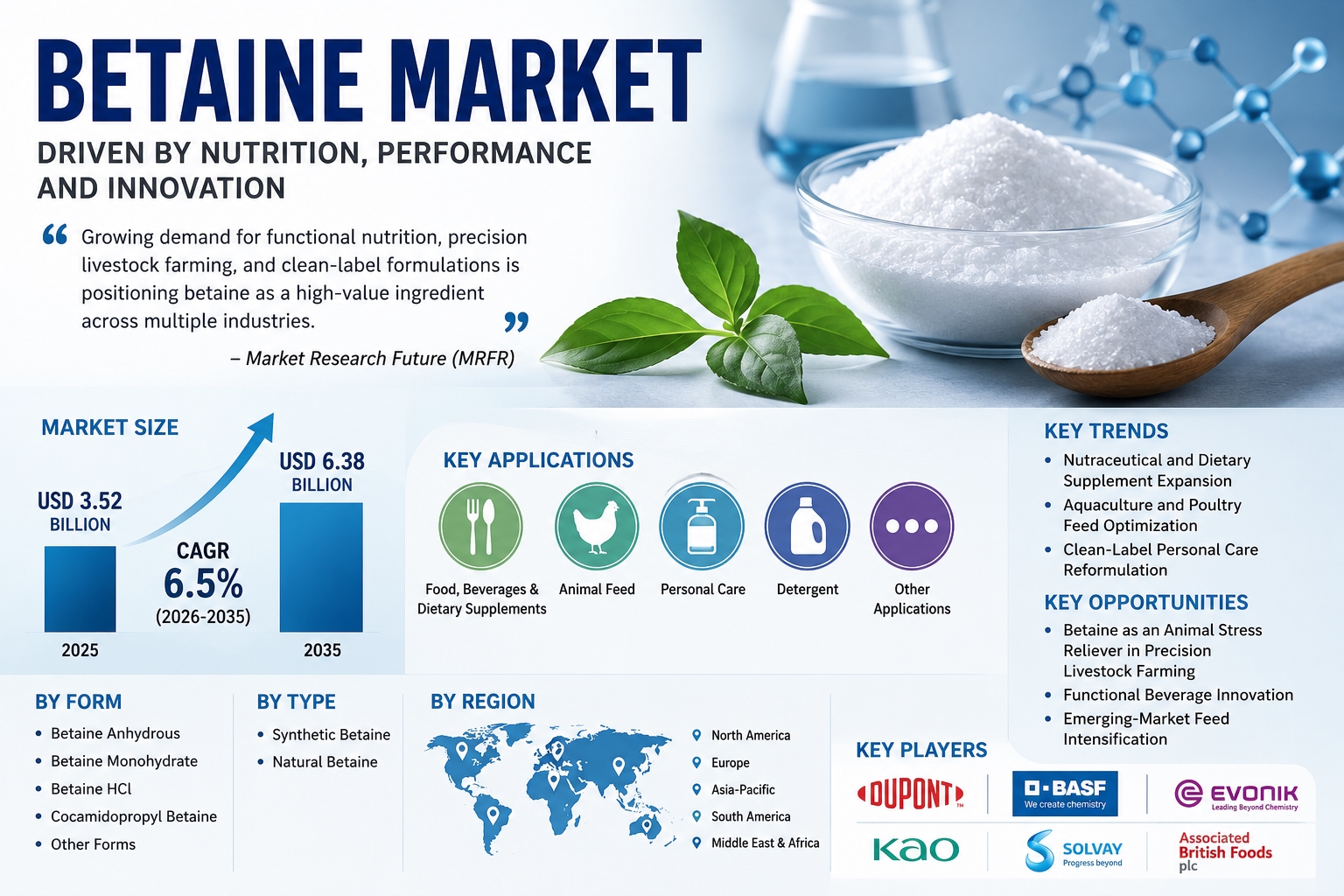
MRFR says the global betaine market will grow from USD 3.52 billion in 2025 to USD 6.38 billion by 2035, expanding at a 6.5% CAGR during the forecast period.
The betaine market is entering a new phase of growth as innovation in nutrition, animal feed, and personal care drives broader commercial adoption worldwide.”
NEW YORK, NY, UNITED STATES, July 13, 2026 /EINPresswire.com/ -- The global Betaine Market is expected to witness steady expansion through 2035, supported by rising demand across dietary supplements, animal feed, personal care, detergents, and functional food and beverage applications. According to the latest research report published by Market Research Future (MRFR), the market is projected to increase from USD 3.52 billion in 2025 to USD 6.38 billion by 2035, registering a compound annual growth rate (CAGR) of 6.5% over the forecast period. This represents an incremental market opportunity of nearly USD 2.86 billion over the decade, underscoring the ingredient’s growing commercial relevance across both consumer and industrial sectors.— Market Research Future (MRFR)
Betaine is a naturally occurring trimethyl glycine compound found in sugar beet, spinach, whole grains, and other plant sources, and it is also produced synthetically for commercial use. Its value lies in its multifunctional properties, including osmoprotection, hydration support, methyl donation, digestive health benefits, and formulation performance. Because of this versatility, betaine is used in food, beverages, dietary supplements, animal nutrition, personal care formulations, and cleaning products. Its broad utility, combined with increasing scientific validation and consumer awareness, is helping position betaine as a strategic ingredient in multiple high-growth markets.
The MRFR report provides a detailed analysis of the global betaine market, examining product forms, sources, applications, regional demand, growth drivers, emerging opportunities, and competitive developments. The study shows that betaine is increasingly benefiting from the convergence of several long-term trends, including the growth of nutraceutical consumption, intensification in livestock and aquaculture nutrition, rising consumer interest in clean-label personal care products, and the search for high-performance ingredients that support health, sustainability, and formulation efficiency. As manufacturers continue to look for ingredients that can deliver multiple functional benefits in a single system, betaine is gaining importance as a versatile and reliable solution.
One of the strongest demand drivers for the market is the expansion of the nutraceutical and dietary supplement industry. Consumers around the world are becoming more proactive about health management, leading to higher demand for products that support digestion, metabolism, hydration, exercise recovery, and overall wellness. Betaine is gaining traction in this context because it is often incorporated into supplements and functional nutrition products designed to support liver health, cellular hydration, and sports performance. It is also increasingly used in pre-workout, endurance, and recovery formulations where consumers are seeking ingredients with both scientific credibility and practical benefits. As more consumers adopt preventive healthcare habits, manufacturers are increasingly formulating products with ingredients that can deliver measurable and scientifically supported benefits.
Get Full PDF Sample Copy of Report: (Including Full TOC, List of Tables & Figures, Chart) @ https://www.marketresearchfuture.com/sample_request/2637
In addition to health-focused applications, betaine is seeing strong growth in the animal nutrition sector. Livestock and aquaculture producers are under growing pressure to improve feed efficiency, enhance animal health, and reduce stress in production environments. Betaine plays a valuable role in feed formulations by supporting osmotic balance, nutrient utilization, and overall performance in poultry, swine, cattle, and aquatic animals. In poultry and aquaculture especially, betaine can help improve resilience under heat stress, dehydration, and changing environmental pressures. It is also valued for its ability to support feed conversion and nutrient retention, which are increasingly important as producers seek to improve productivity while managing costs. As the global demand for animal protein continues to rise, feed formulators are incorporating betaine into precision nutrition strategies aimed at improving performance under variable conditions.
The market is also benefiting from the increasing focus on clean-label personal care reformulation. Consumers are becoming more selective about the ingredients used in skin care, hair care, and cleansing products, creating demand for milder, multifunctional, and more naturally derived ingredients. Betaine is frequently used in personal care products because of its moisturizing, conditioning, and irritation-reducing characteristics. In shampoos, body washes, facial cleansers, baby care products, and lotions, it supports both product performance and consumer-friendly formulation claims. Its compatibility with sulfate-free and sensitive-skin formulations makes it especially attractive to brands seeking to improve mildness without sacrificing cleansing or sensory performance. As personal care brands continue shifting toward cleaner and more transparent ingredient decks, betaine is expected to remain an attractive formulation component.
The report highlights that the market is being shaped by innovation across multiple product forms. Betaine anhydrous continues to hold a prominent position in dietary supplements, food and beverage formulations, and nutritional products because of its versatility and high concentration. Betaine monohydrate is also widely used in human nutrition and specialty formulations where stability and handling are important. Betaine hydrochloride plays a role in digestive health applications, particularly in products targeting gastric support. Cocamidopropyl betaine remains important in personal care and detergent formulations due to its surfactant and foam-enhancing properties, especially in liquid cleansers and mild household products. Other specialized forms also serve niche industrial and consumer requirements, reinforcing betaine’s position as a multifunctional ingredient platform.
From a source perspective, the market is divided into synthetic betaine and natural betaine. Synthetic betaine has traditionally supported a range of industrial and formulation uses because of its consistent quality, reliable supply, and suitability for large-scale applications. At the same time, natural betaine is gaining momentum as demand rises for plant-derived and clean-label ingredients. Consumers and manufacturers alike are increasingly focused on sustainability, transparency, and ingredient traceability, which has created favorable conditions for natural ingredient sourcing. This is especially true in nutrition and personal care segments where label perception and origin matter significantly to buyers. Natural betaine sourced from sugar beet and other botanical feedstocks is expected to gain further traction as brands seek to align with vegan, plant-based, and environmentally conscious positioning.
The food, beverages, and dietary supplements segment remains one of the most important application categories for betaine. In this area, the ingredient is valued for its potential role in hydration, metabolic health, and performance-oriented formulations. Product developers are increasingly using betaine in sports nutrition, energy-support supplements, functional beverages, and wellness products that appeal to active consumers and health-conscious buyers. The rising popularity of ready-to-consume nutrition, fortified beverages, and convenience-driven supplement formats is expected to support continued market growth. Betaine is also being explored in formulations that emphasize clean-label, free-from, and naturally derived claims, which further broadens its appeal in consumer-facing products.
Animal feed applications are another major demand center. Betaine is being increasingly recognized as a useful feed additive in precision livestock farming, where producers seek to optimize productivity while managing animal stress and improving feed efficiency. In poultry and aquaculture in particular, betaine can help improve performance under heat stress, dehydration, and changing environmental pressures. This is particularly important as producers work to maintain output and animal welfare standards amid volatility in raw material costs and environmental conditions. In swine and cattle nutrition, betaine is also valued for its role in supporting nutrient utilization and overall feed performance. As global feed intensification continues in emerging markets, betaine is expected to gain additional traction as a performance-enhancing ingredient.
The personal care segment also offers substantial growth potential. Betaine’s mildness and hydrating properties make it a useful ingredient in shampoos, conditioners, facial cleansers, body washes, and skincare products. Its compatibility with a broad range of surfactants and active ingredients makes it attractive for formulators seeking to balance performance with consumer preference for gentler products. The detergent segment likewise benefits from betaine’s functional properties, where it can improve foaming and cleaning performance while supporting better formulation stability and user experience. In both personal care and household cleaning, betaine is increasingly valued as a way to improve product feel, reduce harshness, and support premium positioning.
According to the MRFR analysis, one of the most important opportunities in the market is the use of betaine as an animal stress reliever in precision livestock farming. As climate variability, heat stress, and production density increasingly affect farm operations, nutritional strategies that help animals cope with stress are becoming more valuable. Betaine’s osmoprotective qualities make it relevant to these challenges, especially in feed programs targeting high-performance animals in poultry and aquaculture. This creates a strong commercial pathway for feed additive manufacturers and livestock nutrition companies, particularly in regions where environmental stress and feed efficiency are major operational concerns.
Another key opportunity lies in functional beverage innovation. Consumers are increasingly drawn to beverages that combine refreshment with health benefits, and betaine can fit naturally into hydration, energy, recovery, and wellness beverage systems. As beverage brands continue to explore new formulations that support active lifestyles, there is growing space for betaine as a differentiating ingredient. The ingredient’s functionality aligns well with the rising demand for beverages that deliver more than taste alone, especially in categories where consumers are looking for convenience, performance, and wellness in a single product.
The report also identifies emerging-market feed intensification as an important growth area. Across Asia-Pacific, South America, the Middle East, and Africa, rising demand for animal protein and improvements in agricultural productivity are driving the modernization of feed systems. In these markets, betaine can support more efficient feeding strategies and help producers improve animal health and productivity. As feed manufacturers expand into these regions, betaine demand is expected to rise alongside broader livestock sector development. This trend is particularly relevant in countries where livestock production is scaling rapidly and producers are seeking ingredients that can improve resilience and output.
The market does face challenges, including raw material price volatility, regulatory compliance, and the need for consistent quality across applications. Because betaine is used in food, feed, and personal care products, suppliers must meet different technical and regulatory standards depending on the end-use segment. In addition, manufacturers are under pressure to maintain supply chain resilience and manage costs while meeting rising expectations for sustainability and traceability. However, ongoing investment in process optimization, regional sourcing, and application-specific innovation is helping to offset these pressures and support long-term market expansion.
Regionally, North America remains a significant market for betaine because of its established supplement industry, advanced animal nutrition sector, and mature personal care market. The region benefits from high consumer awareness, strong product innovation, and widespread adoption of functional ingredients. Europe also represents a strong market, supported by clean-label trends, sustainability-driven ingredient selection, and robust demand in food, feed, and personal care applications. Regulatory emphasis on ingredient transparency and product safety is also encouraging the use of mild, multifunctional ingredients such as betaine.
Asia-Pacific is projected to be one of the fastest-growing regions over the forecast period, driven by population growth, expanding middle-class consumers, rising health consciousness, and growing demand for protein-rich diets and functional nutrition products. Countries such as China, India, Japan, and South Korea are expected to contribute meaningfully to demand growth in both human nutrition and animal feed applications. The region is also seeing strong momentum in personal care and household products, where consumers are increasingly seeking premium, mild, and effective formulations. South America is also expected to witness steady development due to its large agricultural base and increasing livestock production. Meanwhile, the Middle East and Africa are likely to see gradual expansion as consumer markets, feed systems, and personal care industries continue to develop.
The competitive landscape is shaped by major global companies that are investing in product development, manufacturing capabilities, and application-specific innovation. The report identifies DuPont de Nemours, BASF SE, Evonik Industries, Kao Corporation, Solvay SA, and Associated British Foods among the leading players contributing to the market’s evolution. These companies are focusing on improving ingredient quality, expanding global supply chains, and strengthening their positions across nutrition, feed, and personal care categories. Strategic partnerships, research investments, and manufacturing optimization are expected to remain central to their growth strategies. Companies that can combine technical expertise with reliable supply and strong application support are likely to gain the greatest advantage as the market becomes more specialized.
Innovation continues to be a defining feature of the betaine industry. Companies are working to enhance ingredient purity, improve formulation compatibility, and create more specialized product solutions for diverse end uses. Advanced extraction methods, fermentation-based production approaches, and application-focused ingredient development are all helping to expand the commercial relevance of betaine. At the same time, manufacturers are increasingly attentive to sustainability, traceability, and supply chain resilience, especially in markets where clean-label and natural-origin claims are becoming more important. The market is also seeing greater emphasis on technical service and formulation support, as customers increasingly seek ingredients that can deliver both functional and marketing value.
Looking ahead, the global betaine market is expected to maintain positive momentum through 2035 as health, nutrition, and formulation trends continue to evolve. Demand from dietary supplements, animal feed, functional beverages, and personal care products is likely to support long-term growth, while innovations in precision livestock farming and clean-label product development open additional commercial pathways. The market’s expansion reflects the broader shift toward multifunctional ingredients that support health, performance, and formulation efficiency. Companies that can align product development with these priorities are likely to be best positioned to benefit from the market’s growth.
Discover Related Research Reports By Market Research Future:
Pet Dietary Supplements Market
https://www.marketresearchfuture.com/reports/pet-dietary-supplements-market-25536
Lactic Acid In Animal Feed Market
https://www.marketresearchfuture.com/reports/lactic-acid-in-animal-feed-market-27070
Plant Based Protein Supplements Market
https://www.marketresearchfuture.com/reports/plant-based-protein-supplements-market-25692
Sagar Kadam
Market Research Future
+1 628-258-0071
email us here
Legal Disclaimer:
EIN Presswire provides this news content "as is" without warranty of any kind. We do not accept any responsibility or liability for the accuracy, content, images, videos, licenses, completeness, legality, or reliability of the information contained in this article. If you have any complaints or copyright issues related to this article, kindly contact the author above.
