

Stick-Format Face Serums Market to Reach USD 11.9 billion by 2036 with 6.7% CAGR Driven by Precision and Sustainability
Stick-Format Face Serums
Global stick-format face serums gain traction through targeted delivery, eco-friendly packaging, and regulatory compliance across key markets.
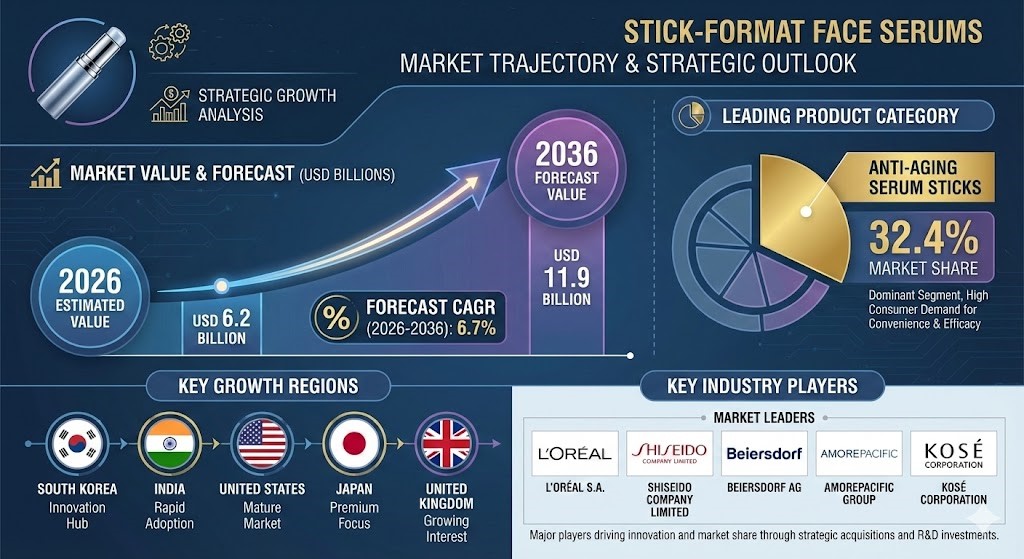
NEWARK, DE, UNITED STATES, February 3, 2026 /EINPresswire.com/ -- The global stick-format face serums market is set to expand significantly from USD 6.2 billion in 2026 to USD 11.9 billion by 2036, exhibiting a compound annual growth rate (CAGR) of 6.7%, according to the latest comprehensive analysis by Future Market Insights (FMI). This growth underscores a notable transformation within skincare, where delivery precision, formulation stability, and packaging innovation are redefining product utility and consumer expectations.
Request For Sample Report | Customize Report |purchase Full Report – https://www.futuremarketinsights.com/reports/sample/rep-gb-31779
Market Overview: Precision and Portability Reshape Skincare
Stick-format face serums, once considered niche or convenience-driven, have evolved into clinically relevant skincare tools that offer targeted, high-concentration treatments. Designed for precise application on wrinkle-prone zones, under-eye areas, and pigmentation spots, these products minimize waste and avoid hand contact, a critical factor for sensitive active ingredients such as retinol, peptides, and fermented extracts.
The solid-state, waterless format facilitates controlled dosing and enhances product stability, supporting modern skincare routines that emphasize efficacy and portability. Retail normalization through major chains such as Sephora and Ulta Beauty signals the format’s maturation from novelty to mainstream treatment vehicle.
Market Drivers: From Innovation to Regulation
Several structural and regulatory forces are driving stick serum market growth:
• Packaging Compliance and Sustainability: New extended producer responsibility (EPR) regulations in the US, Europe, India, and Asia favor lighter, recyclable packaging. Stick serums, typically housed in mono-material polypropylene (PP) or polyethylene (PE), reduce carbon footprints and regulatory burdens associated with traditional glass droppers and pump bottles.
• Retail Integration: Retailers are integrating stick serums into core serum aisles, replacing alternative formats and capitalizing on the format’s logistical advantages such as shelf density, breakage resistance, and easier replenishment.
• Regulatory Safety Requirements: Global mandates like the US FDA’s Modernization of Cosmetics Regulation Act (MoCRA), South Korea’s amended Cosmetic Act, and Japan’s METI certification drive product safety substantiation and recyclability, elevating the stick serum format as a compliance-friendly option.
• Consumer and Institutional Adoption: Institutional mandates banning single-use liquids, alongside consumer demand for mess-free, travel-compliant products, further increase stick serum adoption.
Market Segmentation and Regional Insights
By Product Type:
Anti-aging serums dominate the market with a 32.4% share, driven by demand for targeted wrinkle treatments using high-potency actives. Brightening and acne-fighting sticks show steady growth, especially in Asia and North America.
By Formulation:
Oil-based serums lead with 41.8% market share due to their superior active stability and glide performance, favored in colder climates and aging skin routines. Gel- and water-based sticks are preferred in humid regions for their lighter textures and compatibility with oily skin.
By Distribution Channel:
Online sales account for 38.6% of revenue, supported by digital diagnostics and AI-powered platforms that personalize product recommendations and enhance consumer engagement, notably in Greater China and Southeast Asia.
Geographic Market Forecast (2026–2036 CAGR)
• South Korea: 8.1%
• India: 7.6%
• United States: 6.8%
• Japan: 6.3%
• United Kingdom: 5.9%
Country-Specific Trends
United Kingdom: Regulatory enforcement against misleading environmental claims encourages brands to adopt mono-material, waterless stick serums, supported by major retailers like Boots and Superdrug emphasizing sustainable packaging.
South Korea: The partial amendment of the Cosmetic Act mandates microbial and toxicological safety assessments, compelling brands to develop dossier-ready products. This enhances consumer trust and speeds retailer onboarding.
India: Centralized EPR reporting and cost-sensitive D2C models promote the stick format, which offers reduced packaging and logistical expenses critical for emerging skincare brands.
United States: Under MoCRA, stick serums must meet rigorous safety documentation standards. Retailers actively support solid serums on clean beauty shelves, leveraging their structural simplicity to avoid allergen and contaminant risks.
Japan: METI certification requirements encourage the use of recyclable, mono-material stick packaging, driving compliance and inclusion in public procurement channels.
Competitive Landscape: Science Meets Scale
The stick-format face serums market is led by established multinational beauty groups focused on integrating clinical-grade actives into solid delivery platforms. Key players include:
• L’Oréal S.A. — Leading with dermatological and premium formulations that balance glide and layering compatibility.
• Shiseido Company Limited — Innovating with frictionless, long-wear wrinkle-zone sticks using MolecuShift technology.
• Beiersdorf AG — Applying epigenetic research for solid formulations with portable efficacy.
• Amorepacific Group and KOSÉ Corporation — Dominating Asian markets with brightening and regenerative sticks based on proprietary bioengineering.
• Unilever Plc — Expanding stick serums under brands like Pond’s for humid climates.
• Estée Lauder Companies Inc and Clarins Inc — Driving niche segments such as nighttime sticks and AI-powered skincare consultation platforms.
Market Definition and Scope
The stick-format face serums market encompasses solid-state, waterless skincare products formulated in twist-up or pressed stick form, delivering active ingredients for anti-aging, brightening, hydration, exfoliation, and acne control. It excludes liquid serums, creams, and color cosmetics unless primarily marketed as serums.
Products are distributed via e-commerce, specialty beauty stores, pharmacies, and travel retail channels, with formulations tailored to climate, skin type, and consumer preference.
Outlook and Future Directions
The stick-format face serums market represents a convergence of technological innovation, regulatory compliance, and evolving consumer preferences toward precision, sustainability, and convenience in skincare. With a projected near doubling of market value by 2036, industry stakeholders are poised to benefit from integrating advanced formulation science with eco-conscious packaging and intelligent retail strategies.
Browse Related Insights
Face Steamer Market : https://www.futuremarketinsights.com/reports/face-steamer-market
Liquid Hand Soap Market: https://www.futuremarketinsights.com/reports/liquid-hand-soap-market
Intimate Lightening Products Market: https://www.futuremarketinsights.com/reports/intimate-lightening-products-market
About Future Market Insights (FMI)
Future Market Insights, Inc. (FMI) is an ESOMAR-certified, ISO 9001:2015 market research and consulting organization, trusted by Fortune 500 clients and global enterprises. With operations in the U.S., UK, India, and Dubai, FMI provides data-backed insights and strategic intelligence across 30+ industries and 1200 markets worldwide.
Sudip Saha
Future Market Insights Inc.
+1 347-918-3531
email us here
Legal Disclaimer:
EIN Presswire provides this news content "as is" without warranty of any kind. We do not accept any responsibility or liability for the accuracy, content, images, videos, licenses, completeness, legality, or reliability of the information contained in this article. If you have any complaints or copyright issues related to this article, kindly contact the author above.
