

South Korea Gluten-Free Prepared Food Market Forecast to Reach USD 318.7 Million by 2036
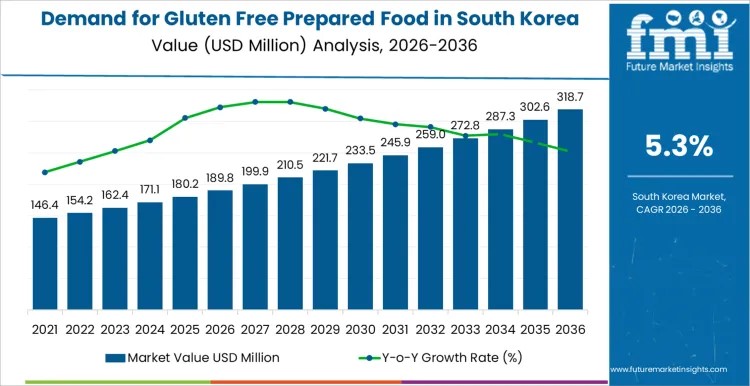
Demand for Gluten Free Prepared Food in South Korea
South Korea’s gluten-free prepared food market is set to grow at a 5.3% CAGR, driven by health trends, labeling reforms, and rising demand for rice-based foods.
NEWARK, DE, UNITED STATES, January 21, 2026 /EINPresswire.com/ -- Demand for gluten-free prepared food in South Korea is entering a decade of steady expansion, supported by shifting dietary habits, heightened awareness of digestive health, and stricter food labeling standards. Revenue from gluten-free prepared food sales is projected to reach USD 189.8 million in 2026 and grow to USD 318.7 million by 2036, reflecting a compound annual growth rate (CAGR) of 5.3%.
The outlook underscores how South Korea’s food industry is adapting to consumer demand for allergen-free, clean-label, and convenient meal solutions. The sector, once a niche category for celiac patients, is evolving into a broader lifestyle segment for health-conscious consumers.
Request For Sample Report | Customize Report |purchase Full Report - https://www.futuremarketinsights.com/reports/sample/rep-gb-31631
Market Overview: What Is Driving Growth and Why It Matters
South Korean consumers are increasingly adopting Western-style diets, resulting in higher wheat consumption. At the same time, awareness of gluten sensitivity is rising, with many individuals self-diagnosing digestive discomfort linked to wheat-based foods. This dual trend is prompting a shift toward rice-based and alternative grain products that align more closely with traditional Korean cuisine.
Urban professionals and single-person households are key contributors to demand, seeking ready-to-eat and “free-from” food options that fit into fast-paced lifestyles. Younger demographics, influenced by wellness trends and clean-label movements, are scrutinizing ingredient lists more closely for allergens and artificial additives.
Public health campaigns aimed at reducing digestive disorders are indirectly raising the profile of gluten-free diets. Together, these behavioral and demographic shifts are redefining gluten-free prepared food from a medical necessity into a mainstream dietary choice.
Regulatory Environment: How Policy Is Shaping the Sector
The Ministry of Food and Drug Safety (MFDS) is enforcing stricter labeling standards to protect consumers with allergies and gluten intolerance. Policymakers are encouraging clearer differentiation between “gluten-free” and “low-gluten” products to prevent misleading claims. Food safety regulations are also being aligned with international standards, compelling manufacturers to upgrade facilities to prevent cross-contamination.
In parallel, government support for the domestic rice industry is influencing ingredient sourcing strategies. Subsidies for processors using locally grown rice flour are reducing reliance on imported wheat and specialty gluten-free inputs. These measures are contributing to a more transparent and safer food supply chain, fostering trust among health-conscious buyers.
Key Market Metrics and Segmentation
• Market size (2026): USD 189.8 million
• Forecast value (2036): USD 318.7 million
• CAGR (2026–2036): 5.3%
• Leading product type: Drinks (43.0% market share)
• Leading sales channel: Supermarkets (57.9% share)
• High-growth regions: Jeju, South Gyeongsang, South Jeolla, North Jeolla
Product segmentation spans beverages, bakery items, ready-to-eat meals, bread and rolls, and pasta. Drinks dominate due to high consumption of functional beverages, rice wines, gluten-free beers, and liquid broths, where hidden gluten residues are a concern.
Supermarkets remain the primary discovery and distribution platform. Large chains such as E-Mart, Lotte Mart, and Homeplus provide dedicated health food sections that aggregate gluten-free items for easier navigation and comparison.
Innovation and Supply Chain Dynamics
Technological advances in food processing are improving the texture and taste of gluten-free bakery and pizza crust products. The use of hydrocolloids and enzymes is helping replicate the mouthfeel of wheat-based foods, while ancient grains such as quinoa and amaranth are being integrated into frozen ready meals to enhance nutritional profiles.
Digital platforms and barcode-scanning apps are playing a growing role in consumer trust, allowing users to verify gluten content instantly. These tools are particularly important for celiac patients who rely on precise labeling accuracy.
Despite progress, supply chain constraints remain a challenge. Dependence on imported gluten-free oats and specialty starches exposes manufacturers to global price volatility. Many producers are mitigating this risk by increasing the use of domestic rice flour, supported by government incentives.
Regional Outlook: Where Growth Is Concentrated
• Jeju (CAGR 6.4%): Tourism-driven demand and wellness retreats are accelerating adoption of gluten-free menus.
• South Gyeongsang (CAGR 5.6%): Industrial zones and corporate cafeterias are expanding allergen-free meal offerings.
• South Jeolla (CAGR 5.1%): Investments in rice processing facilities are strengthening local supply.
• North Jeolla (CAGR 4.3%): Food technology development at the National Food Cluster in Iksan is improving product quality and standardization.
Competitive Landscape and Strategic Positioning
Ener-G Foods, Inc. leads the market with a 30.0% share, supported by dedicated allergen-free facilities and strict cross-contamination protocols. General Mills, Enjoy Life Foods, Udi’s Healthy Foods, and B&G Foods are expanding their presence through partnerships with major Korean retailers and flavor customization for local tastes.
Global brands are incorporating Korean ingredients such as sesame, red bean, and kimchi into gluten-free snacks and emphasizing rice-based formulations on Korean-language labels. These strategies are designed to align international product portfolios with domestic consumer preferences.
Outlook: From Niche Category to Mainstream Segment
The gluten-free prepared food market in South Korea is transitioning from an allergy-driven niche into a broader wellness-oriented segment. Growth is being reinforced by regulatory clarity, technological innovation, and evolving consumer attitudes toward digestive health and clean-label foods.
As quality improves and domestic sourcing expands, gluten-free prepared foods are expected to gain a more permanent place in South Korea’s retail and foodservice ecosystems, supporting long-term sector stability through 2036.
Browse Related Insights
Brown Commercial Seaweed Market https://www.futuremarketinsights.com/reports/brown-commercial-seaweed-market
Functional Foods Market https://www.futuremarketinsights.com/reports/functional-foods-market
Mushroom-Based Snacks Market https://www.futuremarketinsights.com/reports/mushroom-based-snacks-market
About Future Market Insights (FMI)
Future Market Insights, Inc. (FMI) is an ESOMAR-certified, ISO 9001:2015 market research and consulting organization, trusted by Fortune 500 clients and global enterprises. With operations in the U.S., UK, India, and Dubai, FMI provides data-backed insights and strategic intelligence across 30+ industries and 1200 markets worldwide.
Sudip Saha
Future Market Insights Inc.
+1 347-918-3531
email us here
Legal Disclaimer:
EIN Presswire provides this news content "as is" without warranty of any kind. We do not accept any responsibility or liability for the accuracy, content, images, videos, licenses, completeness, legality, or reliability of the information contained in this article. If you have any complaints or copyright issues related to this article, kindly contact the author above.
